
A good deck earns its keep. It gives you somewhere to be on a summer evening, and when the time comes to sell, it’s one of the few outdoor projects that reliably adds to your home value. Which is exactly why letting one slide into disrepair is such a shame.
Maybe yours is getting there. A little gray. A little soft in spots. Boards that creak in a way they didn’t used to.
Every spring, homeowners in Ashland, Framingham, and across MetroWest wrestle with the same deck repair vs. replacement question. Do you repair it? Paint it? Or replace the whole thing with composite material and stop thinking about it for the next 25 years?
The honest answer is that it depends on what shape your deck is actually in. So let’s walk through it the same way our crew would on an estimate visit. Where repair still makes sense, where the repair or replace decision tips, what the costs run around here, and what replacing a wood deck with composite looks like once the truck is in your driveway.
When Is It a Good Idea to Repair a Deck?
Not ready to replace it? Fair. Repairs can stretch a deck’s life by a few more good seasons, but only when the bones underneath are still solid, and that’s the part nobody can judge from a lawn chair.
Figure roughly 20 years for a wood deck that’s been genuinely looked after, and around here, genuinely looked after is a real commitment. A lot of the decks we visit in Ashland and Framingham went up in the early 2000s, which puts them right at that age now. New England winters are brutal on them. Freeze and thaw cycles work fasteners loose, and snow sitting on the boards from December through March keeps moisture parked exactly where you don’t want it. Monthly attention during the season and yearly touch-up repairs are what keep a wood deck on schedule for that 20-year run.
So when does repair win the repair or replace decision? Small stuff. A few loose boards. Popped nails. A railing with some wobble to it. Surface weathering that hasn’t gone deeper. Those are repair jobs, plain and simple. But if the deck is showing widespread age and it’s already hit the 20-year mark, you’re better off putting that money toward replacement instead of restoration.

Should I Try Painting Over an Old Deck?
Painting is the middle path, and honestly, it’s a good one in the right situation. A coat of quality deck paint adds a layer of protection from the elements and can cover up old stains, cracks, and the general tiredness that sets in after years of sun and snow. Done right, it buys you several more seasons of outdoor enjoyment for a fraction of what replacement costs.
It can also just make the deck look great again. Never underestimate the facelift factor.
But painting over an old deck has risks, and this is where we see homeowners get burned. Paint hides problems. It doesn’t fix them.
Before you open a single can, inspect the whole deck. Get underneath it if you can. You’re looking for rotten or warped boards, insect damage, and anything unstable in the structural supports.
If those supports show any sign of rot, stop. Rotted framing needs to be replaced before it damages your home or hurts someone, and no deck paint on the market fixes rot. It only hides it for a season or two, and then you’re dealing with a bigger problem under a fresh coat of paint.
Deck Repair vs. Replacement: Comparing the Costs
For most homeowners, the deck repair vs. replacement decision comes down to money. Fair enough. Here’s how the numbers usually shake out.
Deck repairs typically run between $10 and $50 per square foot. The wider that range feels, the more it reflects reality. Tightening a railing sits at the low end. Replacing rotted boards and reinforcing framing climbs fast.
Composite decking material itself costs an average of $4 to $13 per square foot before installation. Once you fold in installation and substructure work, a composite replacement lands between $30 and $60 a square foot.
One thing the cost sheets never mention: matching. Finding replacement boards that match a weathered 15-year-old deck is nearly impossible. New boards next to old ones look like exactly what they are. If mismatched patches would bother you every time you walked outside, replacement might make you happier than repair ever could.
There’s a middle scenario worth knowing about, too. If your framing is still in good shape, swapping just the old wood boards for composite can be the most cost-effective move of all, because the new surface will outlast wood boards by a wide margin.
And if the framing itself is failing? That’s not a cost question anymore. That’s a safety question, and the answer is replacement. Always follow your city’s regulations on deck substructures.

Replacing a Wood Deck with Composite: What the Process Looks Like
Replacing a wood deck with composite is one of the projects we get asked about most, so here’s what it actually looks like when our crew shows up.
Demo comes first. Boards, railings, and any framing that’s compromised all come off. If the existing framing is sound and up to code, sometimes it stays, which helps the budget. If it isn’t, we rebuild it with properly flashed, waterproofed framing. There’s no point putting a 25-year decking surface on a foundation that won’t last five.
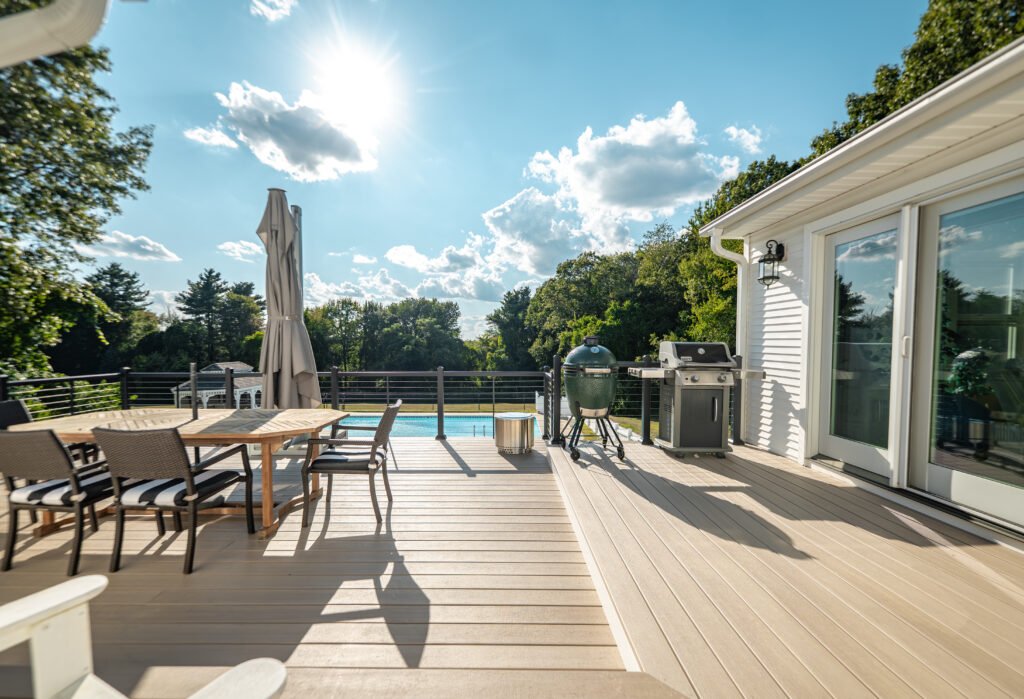
Then the composite goes down, followed by railings and trim. Because the boards are engineered, the lines stay crisp and the color runs consistent across the whole deck. A patched wood deck can never quite pull that off.
We did exactly this at a home in Westborough recently. The old wood deck had deteriorated to the point where the family had stopped using it. Our team rebuilt it from the ground up with TimberTech composite decking, waterproofed framing, and a cable railing system that keeps the backyard view open instead of fencing it in. They went from a deck they avoided to an outdoor space built to shrug off decades of New England weather.
Timing-wise, most full replacements of an average deck take our crew one to two weeks, depending on framing condition, permits, and what the weather decides to do.
Can You Resurface an Existing Deck with Composite?
Sometimes, yes. Resurfacing an existing deck with composite means pulling off just the walking surface and railings, then installing composite boards over the original framing.
The catch is that the framing has to genuinely earn it. Composite boards weigh more than wood, and some brands call for tighter joist spacing than an older deck was built with. So the substructure gets inspected first. Every joist, every post. If a contractor offers to resurface your deck with composite without crawling underneath and checking, get a second opinion.
When the framing passes, resurfacing saves real money. You skip the demolition and rebuild entirely. When it doesn’t pass, resurfacing is just a new surface on a failing foundation, and that’s not a corner worth cutting on something your family stands on.
What Is Composite Material?
Wood decks look great. Nobody argues that. But wood is vulnerable to weather, which means a natural wood deck needs ongoing treatment, painting, staining, and sealing just to stay protected.
Composite decking is the alternative that’s won over a huge share of homeowners, and for good reason. It’s typically made from a blend of recycled plastic thread and sustainable wood materials like bamboo, which produces a board that’s more durable and more stable than plastic decking on its own.
Composite has been around for decades, but the material has come a long way. Today’s composite decking is easier to work with, comes in far more varieties, and looks much closer to real wood than the early stuff ever did.
Composite Material Uses
Decking is where most people know composite from, but the material shows up everywhere. Bridges. Buildings. Storage tanks. Swimming pool panels.
It’s common indoors, too, in bathtubs and shower stalls, and it’s an integral ingredient in imitation granite countertops and marble sinks. There’s even composite material in race car bodies and boat hulls.
Composite Material Benefits for Homeowners
Beyond versatility and cost-effectiveness, composite brings a long list of benefits to a deck. Here are seven that matter most in day-to-day life.
Extreme Durability
Composite outperforms natural wood on durability, and it isn’t close. The material resists scratching, fading, and mold, and it won’t warp, rot, splinter, or crack with age.
Spill the food. Drop the greasy grilling tools. Let the dogs run. None of it is going to hurt a composite deck.
Naturally Weatherproof
Because it contains plastic, composite decking carries a built-in seal that repels water. No extra treatments needed to protect it from the elements.
That’s an ongoing cost you simply get to delete. Wood decks need a fresh coat of paint or sealant every few years. Composite doesn’t ask for either.
Are Composite Decks Maintenance-Free?
About as close as a building material gets. A wood deck demands real yearly upkeep. Washing, staining, sealing, sometimes several days of it. Composite lasts for decades without much effort at all.
Cleaning a composite deck means a gentle scrub with soap and water, maybe once or twice a year, barring a major spill. That’s it. There’s no protective coat to add because the material protects itself.
If your goal is to spend your deck time enjoying the deck rather than maintaining it, composite is hard to beat.
Long-Lasting
Low-maintenance longevity is the benefit homeowners rave about most. Composite decking typically lasts 25 to 30 years.
A wood deck can last anywhere from 20 to 40 years, sure. But factor in the hours and dollars maintenance eats up over that span, and composite is most often the better deal.
Environmentally-Friendly
Composite doesn’t contribute to deforestation the way wood decking does, so you get the look and feel of wood without the guilt.
One caveat worth your attention: not every composite product is made with sustainability in mind. It pays to ask your supplier what actually goes into their boards. Recycled polyethylene and wood scraps are the most common recycled ingredients you’ll find.
Splinter-Free
Here’s the one the whole family notices. Composite can’t splinter. The material fuses together like a woven garment, so there’s simply nothing to split off.
Kids barefoot. Dogs at full speed. Nobody’s pulling splinters out of anybody on a composite deck.
Color Choices
It used to be that choosing composite meant settling on color. Plenty of people stuck with wood purely because you could paint it any shade you wanted.
Not anymore. Composite decks now come in just about every color you could ask for, and the color is built to stay. No fading to chase, no paint to match. The hue you pick is the hue you keep.
Common Questions About Composite Decking
Will composite decking rot?
No. Composite decking won’t rot the way wood does. The plastic content seals out the moisture that causes wood rot, which matters a great deal in a climate where decks spend four months a year under snow. What can deteriorate is the wood framing underneath if it was built untreated or poorly flashed. That’s why we always inspect and waterproof the substructure when replacing a wood deck with composite.
Can you paint or stain composite decking?
You generally shouldn’t, and with modern composite you don’t need to. The color runs through the board and is designed to resist fading, so paint and stain struggle to bond and tend to peel. If you’ve fallen out of love with your composite deck’s color, swapping boards is the better long-term fix than fighting the material with paint. Older first-generation composite is occasionally an exception, and even then results are hit or miss.
Are composite decks really maintenance-free?
Essentially, yes. A soap-and-water wash once or twice a year covers it. No sanding, no sealing, no staining, no repainting. That’s the part of wood deck ownership that quietly eats weekends and money, and composite removes it from the calendar entirely.
Is a composite deck worth it?
For most homeowners planning to stay put more than a few years, yes. Replacing a wood deck with composite costs more upfront than repairing or repainting. But composite runs 25 to 30 years with almost nothing spent on upkeep, and when you eventually sell, Greater Boston buyers notice a deck that doesn’t need work. Stack that against a repair-and-repaint cycle that comes back around every few years, and the math usually lands on composite’s side.
Ulta Home Improvement is a Boston Area Best Picks Top Contractor
Most homeowners we meet haven’t decided yet, and there’s a good reason for that. The repair or replace call is nearly impossible to make from the top of the deck, because the answer usually lives underneath it. Our team is happy to walk your deck with you, crawl under it if that’s what it takes, and give you a straight answer about whether repairing, painting, or replacing with composite makes the most sense for your home. For all of your Massachusetts home improvement needs, trust Ulta Home Improvements. Contact us for a convenient, free consultation.